Logging and the River Drives
Lumber camps and the spring drives
The forests and waterways of Aroostook County shaped an entire way of life defined by seasonal timber harvests and historic river drives. From early border disputes over white pine stands to downstream drives across the St. John and Allagash rivers, lumber operators built thriving communities around northern mills.
 Your logo here
This page could be sponsored
Your business name here
Sponsor This Page
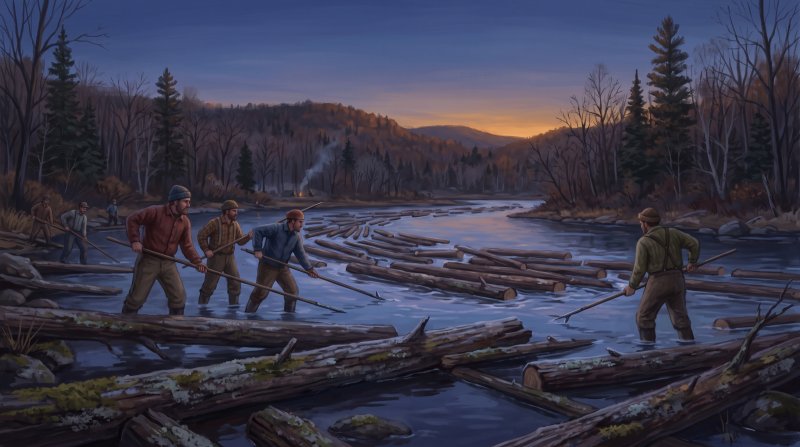
The tradition of logging and river drives in Aroostook County developed around a demanding winter rhythm. Crews spent the coldest months packing snow and icing hauling roads so heavy sleds could haul sawlogs to riverbanks before spring meltwater carried them downriver on log drives. In the early nineteenth century, stands of white pine along the Aroostook River were so valuable that timber trespasses fueled the Aroostook War boundary dispute, leading Maine troops to construct blockhouses and river booms at Fort Fairfield and Fort Kent to prevent floating logs from escaping into Canadian waters. Following the Webster-Ashburton Treaty in 1842, Maine retained the timber-rich Aroostook River valley alongside forests along the Fish and Allagash rivers, securing local resources for settlements like Ashland at the junction of the Big Machias and Aroostook rivers.
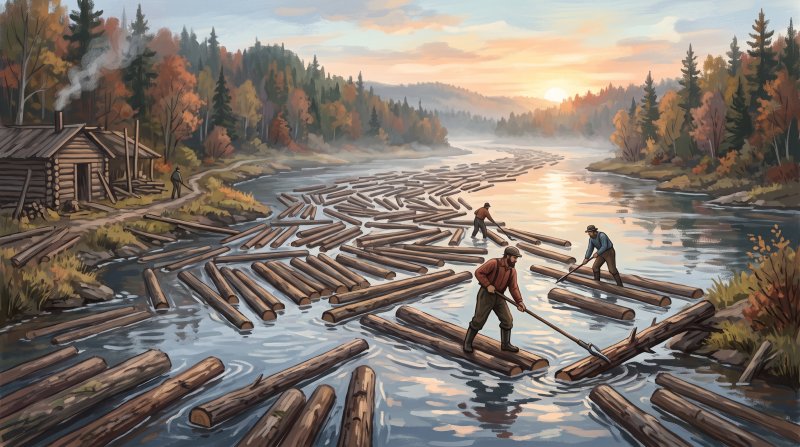
Water served as the main highway for northern timber long before tracks crossed the landscape. Woodsmen guided massive timber runs down the Allagash and St. John rivers toward downstream sawmills, using stopping depots like the Moir Farm and dams such as Long Lake Dam to regulate downstream currents all the way to Van Buren. Lumber operator Edouard Lacroix established the Madawaska Lumber Company, bought the Keegan Mill in Van Buren, and laid a supply road crossing the St. John River at Nine Mile Bridge. His crews harvested long logs and four-foot pulpwood, driving timber down northern waterways to feed local mills. Decades later, during spring 1944 wartime shortages, river boss John Gardner of Allagash Plantation directed 150 drivers on a 45-million-board-foot drive down the St. John River to Keegan.
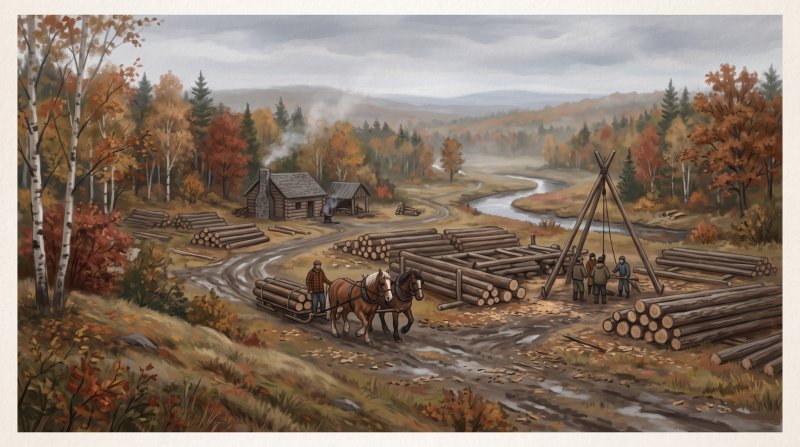
Transportation changed dramatically when the Bangor & Aroostook Railroad arrived in Fort Kent in 1899, followed by the Fish River Railroad in 1902. This allowed mills in the Upper St. John Valley to send cut lumber directly south toward American domestic markets rather than depending entirely on downstream drives into New Brunswick. Today, visitors trace this heritage across the region, exploring logging exhibits and replica double camps at the Ashland Logging Museum, the Churchill Depot History Center along the Allagash Wilderness Waterway, the Acadian Archives in Fort Kent, and local collections in Caribou, Houlton, and Allagash.
Where to go: St. John Valley · Central Aroostook · Southern Aroostook · North Woods
Every fact on this page comes from the sources listed below. Histories are told in many ways, so where sources differ we say so.
The facts behind this history
·
Background and causes (6)
- Blockhouse boom defense at Fort Kent Fort Kent
- At Fort Kent, troops used a blockhouse fortification to guard a river boom across the Saint John River, preventing floating logs from passing into Canadian waters.[1]
- Boundary dispute fueled by Aroostook timber Aroostook River
- Tensions leading to the 1838–1839 Aroostook War peaked because valuable white pine stands along the Aroostook River led Maine and New Brunswick loggers to cut timber in contested territory.[2]
- Rail expansion connecting Fort Kent lumber Fort Kent
- The arrival of the Bangor & Aroostook Railroad in 1899 and the Fish River Railroad in 1902 at Fort Kent enabled local lumber operators to ship milled timber directly south to American domestic markets rather than depending entirely on downstream Canadian river drives.[3]
- River booms defended at Fort Fairfield Fort Fairfield
- During the Aroostook War, blockhouses were constructed at Fort Fairfield to protect log booms placed across the Aroostook River to keep harvested timber from being driven downstream into Canada.[1]
- Seasonal winter logging cycle in Aroostook Aroostook County
- Aroostook County logging crews operated primarily during winter, packing snow and icing hauling roads so heavy sleds could move sawlogs to riverbanks before spring meltwater carried them downriver on log drives.[4]
- St. John River timber transport to Canadian mills Saint John River
- Before local railroads were constructed, operators in the Upper St. John Valley routinely drove harvested timber down the Saint John River to mills in New Brunswick because transporting logs south to American coastal markets was far more difficult.[3]
Key events and dates (7)
- Bangor & Aroostook Railroad alters timber transport Fort Kent
- The arrival of the Bangor and Aroostook Railroad in Fort Kent in 1899 allowed Upper St. John Valley lumbermen to transport wood products directly to American domestic markets instead of driving logs exclusively downriver to New Brunswick mills.[5]
- British timber trespasses on the Aroostook River Aroostook River
- In 1825, Maine Governor Albion Paris received official reports that British subjects were cutting timber along the Aroostook River under British permits, employing at least 100 teams of six oxen each.[6]
- Ezekiel Holmes survey of Aroostook lumbering Masardis
- During an 1838 state exploration and survey of the Aroostook River territory, Dr. Ezekiel Holmes observed of the St. Croix Stream tributary at Masardis that lumbering would be the order of the day upon it for many years.[6]
- Houlton logging crew departs for Big Machias Houlton
- In November 1841, merchant Shepard Cary dispatched a ten-man logging crew with four teams of horses from Houlton to swamp and haul pine timber along the Big Machias River.[7]
- Salmon Stream timber confrontation Washburn
- In 1839, Maine Deputy Land Agent George W. Buckmore confronted New Brunswick lumbermen felling white pines along Salmon Stream in Washburn, where the loggers refused to halt operations, intensifying the border dispute.[6]
- St. John River wartime log drive to Keegan Keegan
- In spring 1944, river boss John Gardner led 150 river drivers on a 45-million-board-foot drive down the St. John River from the Allagash area to the Van Buren Madawaska Lumber Corporation mill at Keegan.[8]
- Webster-Ashburton Treaty secures Aroostook timberlands Aroostook River
- The Webster-Ashburton Treaty signed in August 1842 resolved the Aroostook War boundary dispute, ensuring Maine retained the timber-rich Aroostook River valley and forests along the Fish and Allagash rivers.[6]
Legacy today (8)
- Acadian Archives Logging Collections Fort Kent
- The Acadian Archives at the University of Maine at Fort Kent preserves historic records, film footage, oral histories, and tools documenting 20th-century logging and lumber camps in Aroostook County.[9]
- Ashland Logging Museum 1880s Camp Replica Ashland
- The Ashland Logging Museum features an 1880s replica double log camp and exhibits detailing late 19th- and early 20th-century logging life, equipment, and river log-hauling tools.[10]
- B Stream Log Drive Records Houlton
- The Aroostook County Historical and Art Museum preserves photographs and historical records of spring log drives on B Stream, where Cedar Dam previously regulated water levels to float logs to market.[11]
- Caribou Historical Center Lumber Exhibits Caribou
- The Caribou Historical Center and Whittier Museum preserves and displays early northern Maine lumber tools, equipment, and agricultural implements from Aroostook County settlers.[12]
- Churchill Depot History Center T10 R12 WELS
- Located at the site of the former Madawaska Company lumber headquarters along the Allagash Wilderness Waterway, the Churchill Depot History Center operates as an interpretive museum of early north woods logging operations.[13]
- Fort Kent Logger Fest Fort Kent
- Fort Kent hosts the annual Logger Fest, a community festival commemorating the St. John Valley's logging traditions and river-driving heritage with timber sports, historical exhibits, and demonstrations.[14]
- Historic St. John Lumber Company Bottom Dump Wagon Ashland
- A restored Watson bottom dump wagon used in the early 20th century by the St. John Lumber Company to construct the Long Lake Dam for controlling Allagash River log drives is preserved in Aroostook County collections.[14]
- King's Arrow Pine Display Ashland
- The Ashland Logging Museum preserves and exhibits a trunk section of a historic King's Arrow Pine bearing King George's broad arrow mark, salvaged from unorganized territory near Oxbow.[15]
People (6)
- David Collins Builds Shingle Mill on Otter Brook Caribou
- In 1854, David Collins built a dam and shingle mill at the mouth of Otter Brook where it flows into the Aroostook River, utilizing the waterway to power lumber processing.[16]
- Edouard Lacroix Acquires Keegan Mill Van Buren
- Edouard Lacroix established the Madawaska Lumber Company and purchased the Keegan Mill in Van Buren along the St. John River from International Paper to process his northern Maine timber cuts.[17]
- Edouard Lacroix Constructs Nine Mile Bridge St. John River
- Lumber operator Edouard Lacroix built a supply road that crossed the St. John River at Nine Mile Bridge to supply his logging and depot camps in northern Aroostook County.[18]
- Edouard Lacroix Drives Long Logs to Keegan Van Buren
- Edouard Lacroix ran logging crews that harvested long logs and four-foot pulpwood in the northern woods and drove them down the Allagash and St. John rivers to his mills in Keegan.[17]
- John Gardner Bosses St. John River Drive Allagash
- John Gardner of Allagash Plantation bossed a 45-million-foot log drive down the St. John River to the Van Buren Madawaska Lumber Corporation sawmill in Keegan during the spring of 1944.[19]
- William Dalton Settles at Big Machias Junction Ashland
- In 1835, William Dalton settled at the junction of the Big Machias and Aroostook rivers, establishing the site that became Ashland and served as a major center for upper Aroostook logging operations.[20]
Places (6)
- Acadian logging along the Allagash and St. John Van Buren
- Local woodsmen such as Hampy Martin in the 1920s–1930s and Roland Perreault in the 1950s–1960s logged extensively throughout the Allagash region, using river dams like the Long Lake Dam whose releases controlled water flows reaching more than 100 miles downstream to Van Buren.[21]
- Allagash timber drives to Van Buren Allagash
- In the 1930s, logging crews based at camps along the Allagash River cut timber through the winter and launched spring log drives following ice-out, driving logs over one hundred miles downstream to sawmills in Van Buren along the St. John River.[22]
- Fort Fairfield boom dispute in the Aroostook War Fort Fairfield
- During the Aroostook War border dispute in spring 1839, log-driving operations on the Aroostook River led Maine authorities to maintain a timber boom at Fort Fairfield to impound and separate disputed timber floating downriver.[23]
- Moir Farm stopping place on the Allagash River Allagash
- The Moir Farm along the Allagash River in northern Aroostook County served as a vital mid-river stopping place and supply depot for lumbermen and river drivers navigating the waterway during the late 19th century.[24]
- St. John River wartime log drive to Keegan Keegan
- In spring 1944, a 45-million-board-foot log drive was organized down the St. John River from Allagash to Keegan to supply the Van Buren Madawaska Lumber Corporation sawmill during wartime lumber shortages.[25]
- Weeks Mill at the confluence of the St. Croix and Aroostook rivers Masardis
- The Weeks Brothers lumber mill operated circa 1910 in Masardis at the junction of the St. Croix and Aroostook rivers, manufacturing long and short lumber from timber driven down the waterways.[26]
Where to learn more (5)
- Allagash Historical Society river drive exhibits Allagash
- The Allagash Historical Museum maintains dedicated historical displays and photographs documenting early settler life, regional lumbering, and St. John River log drives in the town of Allagash.[27]
- Ashland Logging Museum double camp and equipment Ashland
- The Ashland Logging Museum preserves northern Maine's logging history with an open-air setup featuring an 1880s replica double log camp, Lombard log haulers, and vintage logging equipment and tools.[10]
- Fort Kent Historical Society lumber collection Fort Kent
- The Fort Kent Historical Society operates a museum complex centered around the historic 1902 railroad station, maintaining collections and exhibits on the town's history as a lumber shipping center.[28]
- Houlton Museum B Stream log drive records Houlton
- The Aroostook County Historical and Art Museum in Houlton preserves historical photo records and accounts of early spring river drives, including operations regulated by the former Cedar Dam on B Stream.[11]
- King's Arrow Pine exhibit at Ashland Logging Museum Ashland
- The Ashland Logging Museum displays a section of an old-growth King's Pine cut down in northern Maine during the 1960s that still bore the historic 'broad arrow' timber mark.[29]
Sources (29)
- The First Shots Fired in the Aroostook War — aroostookhistory.me , viewed Oct 16, 2026
- Aroostook War (1839) - Maine Digital Archives — digitalarchives.maine.gov , viewed Oct 16, 2026
- Woods Work - Acadian Culture in Maine — acim.umfk.edu , viewed Oct 16, 2026
- LOGGING CAMP IN AROOSTOOK COUNTY, MAINE. Circa 1895. Historically, in — woodprairie.com , viewed Oct 16, 2026
- Woods Work - Acadian Culture in Maine — acim.umfk.edu , viewed Oct 16, 2026
- Early days on the Aroostook River - The County — thecounty.me , viewed Oct 16, 2026
- Aroostook Seventy Years Ago by Author Dr. Dena Winslow — aroostookhistory.me , viewed Oct 16, 2026
- LUMBER: Big Drive - TIME — content.time.com , viewed Oct 16, 2026
- Logging--Maine--Aroostook County | ArchivesSpace Public Interface — acadianarchives.library.umfk.edu , viewed Oct 16, 2026
- Ashland Logging Museum - TravelMaine.com — travelmaine.com , viewed Oct 16, 2026
- Log drive on B Stream | acham - The Houlton Museum — achamuseum.com , viewed Oct 16, 2026
- Museums and more in Aroostook County - Bangor Daily News — bangordailynews.com , viewed Oct 16, 2026
- History in Maine - Undiscovered Maine - The University of Maine — umaine.edu , viewed Oct 16, 2026
- Can-Am honors northern Maine history at Logger Fest - Bangor Daily News — bangordailynews.com , viewed Oct 16, 2026
- Travel back to the past, experience life in the North Woods at Ashland museum — bangordailynews.com , viewed Oct 9, 2026
- The Aroostook River: The Source of Riverbed Art — caribouhistorical.org , viewed Oct 16, 2026
- Lacroix's Legacy - North Maine Woods — northmainewoods.org , viewed Oct 16, 2026
- Edouard “King” Lacroix Was a Canadian Lumber Baron — awwf.org , viewed Oct 16, 2026
- LUMBER: Big Drive - TIME — content.time.com , viewed Oct 16, 2026
- Towns in northern Aroostook County: history and early settlers - The Upper St. John River Valley — upperstjohn.com , viewed Oct 16, 2026
- Where Sled dogs meet Sawdust - Greater Fort Kent Area Chamber of Commerce — fortkentchamber.com , viewed Oct 16, 2026
- Jalbert Brook Logging Camp 1938 New YouTube — youtube.com , viewed Oct 16, 2026
- Forts, Writs and Logs: A Reassessment of the Military, Political and Economic Dimensions of the Maine/New Brunswick Border Dispute — digitalcommons.library.umaine.edu , viewed Oct 16, 2026
- The Moir Farm part of rich Allagash history - Bangor Daily News — bangordailynews.com , viewed Oct 16, 2026
- LUMBER: Big Drive - TIME — content.time.com , viewed Oct 16, 2026
- Weeks Mill, Masardis, ca. 1910 - Maine Memory Network — mainememory.net , viewed Oct 16, 2026
- Sites - Maine Acadian Heritage Council — acadianheritagecouncil.org , viewed Oct 16, 2026
- Fort Kent Historical Society Museum and Daigle-Dube House - TravelMaine.com — travelmaine.com , viewed Oct 16, 2026
- The King's Arrow Pine - Axe Women Loggers of Maine — axewomen.com , viewed Oct 16, 2026
Last updated October 17, 2026.