Potato Farming
The crop that made The County
Potato farming in Aroostook County began in the early 1800s when settlers discovered the region's well-drained loam soils and cool climate. Over two centuries, northern Maine evolved through an era of bustling starch factories, rail expansions, and dedicated agricultural research into a renowned potato growing center. Today, communities preserve and celebrate this working heritage through harvest traditions, museums, and summer festivals.
 Your logo here
This page could be sponsored
Your business name here
Sponsor This Page
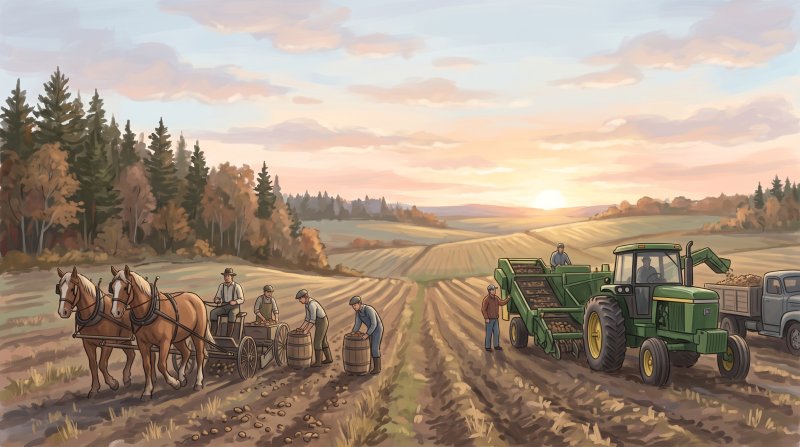
The story of potato farming in Aroostook County began in June 1807, when Joseph Houlton planted the first recorded crop of Early Blue, or Blue Nose, potatoes. Early settlers clearing land across the county soon planted more acreage after discovering that the region's well-drained loam soils and cool climate suited the crop. Early commercial shipments moved quickly; Fort Fairfield Custom House accounts from 1833 recorded 342,355 bushels of potatoes alongside 2,692 tons of starch, which consumed 670,500 bushels. By 1871, Alba Holmes converted an unused woolen mill in Caribou into the county's first potato starch factory, and a builder named Wheeler constructed another mill in Presque Isle in 1874, contracting acreage with local farmers to purchase potatoes at 25 cents per bushel. By 1890, forty-two starch factories operated across the county to absorb surplus harvests, expanding to 62 factories by 1900. When the Bangor and Aroostook Railroad reached Houlton in January 1894, joining rail links established to Presque Isle and Caribou in 1881, direct shipping opened to major urban markets like Boston and New York, spurring the creation of 1,000 new farms between 1890 and 1900.
Inventive growers and merchants shaped the industry at every turn. Elisha E. Parkhurst introduced potato spraying to produce good crops, built an early starch factory, and raised seed and table stock in Presque Isle, while E. L. Cleveland established a major commercial seed business in Houlton handling Green Mountain, Irish Cobbler, and Spaulding Rose varieties. Russian immigrant Hiram Adelman built one of the county's largest operations in Mars Hill, and Silas W. Taber patented an improved drop-axle wagon gear in 1903 that lowered wagon beds to ease loading heavy barrels in the field. Seeking scientific backing for their work, starch and potato leader Thomas Phair and fellow businessmen persuaded the Maine Legislature in 1913 to fund a dedicated demonstration station. In 1914, the Maine Agricultural Experiment Station purchased the 275-acre Greenwood Farm south of Presque Isle to establish Aroostook Farm, where researchers studied tillage methods, fertilizers, and disease management. Now encompassing 425 acres on Houlton Road as the University of Maine's research and extension center, the facility tests storage methods and breeds disease-resistant varieties, including the Caribou Russet released in 2015.
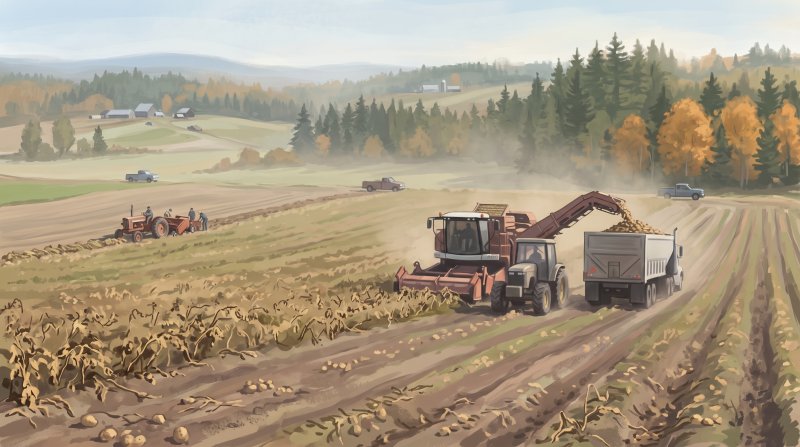
Fieldwork forged deep community rhythms throughout northern Maine. Early manual harvests relied on workers filling ash baskets and emptying them into wooden barrels, receiving numbered identification tickets to track pay. To support the fields, schools in Saint Agatha, Caribou, and across the county formally scheduled two- to three-week autumn harvest recesses beginning around 1945 so students could assist local farms. Even as mechanized one-row and two-row diggers began appearing in the 1940s and 1950s—such as those David Merritt adopted on his Pease Road farm in Mapleton to lay out potatoes for hand harvest into cedar barrels—manual pickers still set remarkable marks, including a picker who filled 142 cedar barrels in a single day at Donald Gallagher's Fort Fairfield farm in 1962. Growers continued to refine their fields over time, even experimenting with sugar beets as a rotation crop during the 1970s before dropping them due to harvest scheduling conflicts.
That deep agricultural past remains a visible part of local life. In Littleton, the Southern Aroostook Agricultural Museum preserves harvest heritage with historic barrel-making tools, seed cutters, graders, bags, and horse-drawn diggers in the Hagan Barn, alongside a giant harvest basket handwoven by Micmac artisan Richard Silliboy. In Fort Fairfield, the annual multi-day Maine Potato Blossom Festival, established in the 1930s, continues to celebrate the commercial industry every July when the fields come into bloom.
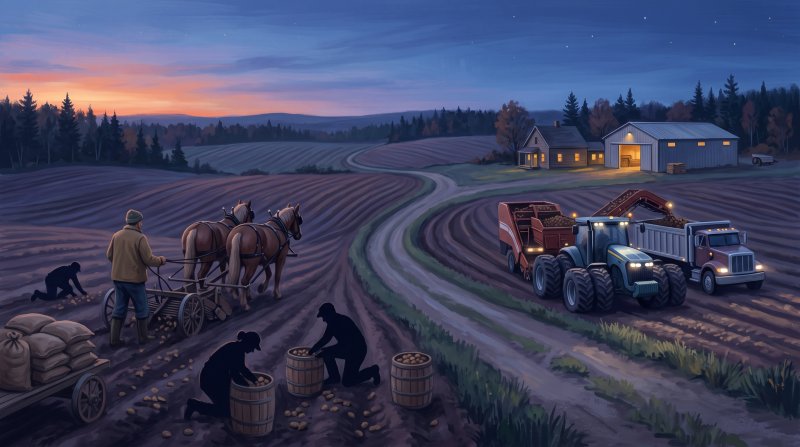
Where to go: Central Aroostook · Southern Aroostook
Every fact on this page comes from the sources listed below. Histories are told in many ways, so where sources differ we say so.
The facts behind this history
·
Background and causes (8)
- Bangor and Aroostook Railroad Line Expansion Houlton
- The opening of the Bangor and Aroostook Railroad to Houlton in January 1894 provided direct shipping access to major urban markets, spurring the creation of 1,000 new farms between 1890 and 1900.[1]
- Early Commercial Production and Starch Consumption Fort Fairfield
- Fort Fairfield Custom House accounts from 1833 recorded Aroostook River area shipments that included 2,692 tons of starch, which consumed 670,500 bushels of potatoes, alongside 342,355 bushels of potatoes.[2]
- Early Potato Cultivation and Settlement Bridgewater
- In the early 1800s, settlers clearing land in Aroostook County planted potatoes after discovering the region's well-drained loam soils and cool climate were suitable for the crop.[3]
- Establishment of Aroostook Farm Research Station Presque Isle
- In 1914, land was purchased south of Presque Isle to establish Aroostook Farm, where agricultural researchers tested potato tillage methods, disease management, and fertilizers.[4]
- First Starch Factory in Caribou Caribou
- In 1871, Alba Holmes converted an unused woolen mill in Caribou into Aroostook County's first factory to manufacture potato starch.[2]
- Growth of Starch Factories in Aroostook County Houlton
- By 1890, forty-two potato starch factories had been constructed across Aroostook County to absorb surplus production and supply national starch markets.[5]
- Harvest Break for Potato Picking Caribou
- Beginning around 1945, schools in Aroostook County formally scheduled an annual two- to three-week recess each autumn so students could assist farmers in harvesting the potato crop.[6]
- Presque Isle Starch Factory Construction Presque Isle
- A starch factory was constructed in Presque Isle in 1874 by a builder named Wheeler from New Hampshire to process local potato harvests.[2]
Key events and dates (8)
- Caribou Russet Variety Released Presque Isle
- The Caribou Russet potato variety was released in 2015 following development at Aroostook Farm in Presque Isle.[7]
- First Aroostook Starch Factory Established Caribou
- In 1871, Alba Holmes converted an unused woolen mill in Caribou into the first potato starch factory in Aroostook County.[8]
- Formal School Harvest Breaks Recorded Saint Agatha
- Formal school harvest recesses excusing students for two to three weeks to work the potato harvest have been documented in Aroostook County since at least 1945.[9]
- Mechanized Harvesters Introduced Presque Isle
- Mechanized potato harvesters were introduced in the 1940s, significantly reducing manual field labor across the county.[10]
- Presque Isle's First Potato Starch Mill Presque Isle
- In 1874, a New Hampshire resident named Wheeler built the first potato starch factory in Presque Isle.[8]
- Purchase of Aroostook Farm for Research Presque Isle
- In 1914, the agricultural experiment station purchased the 275-acre Greenwood Farm in Presque Isle to conduct potato cultivation and crop research.[11]
- Starch Factory Network Across Aroostook Presque Isle
- By 1900, Aroostook County had 62 potato starch factories in operation, driven by demand for commercial starch.[12]
- Sugar Beet Rotation Experimentation Easton
- During the 1970s, Aroostook County farmers experimented with sugar beets as a rotation crop with potatoes, but dropped them due to harvest scheduling conflicts.[13]
Legacy today (4)
- Maine Potato Blossom Festival Fort Fairfield
- Fort Fairfield hosts the annual multi-day Maine Potato Blossom Festival, a tradition originating in the 1930s that celebrates Aroostook County's commercial potato industry during the July blooming season.[14]
- Southern Aroostook Agricultural Museum Potato Basket Littleton
- The Southern Aroostook Agricultural Museum displays what is promoted as the world's largest potato basket, a giant version of the traditional Aroostook ash harvest baskets handwoven by Micmac artisan Richard Silliboy.[15]
- Southern Aroostook Agricultural Museum Potato Exhibits Littleton
- The Southern Aroostook Agricultural Museum preserves regional farming heritage with a dedicated potato house room displaying antique potato bags, seed cutters, graders, and scales, along with historic harvest memorabilia and a barrel shop.[15]
- University of Maine Aroostook Farm Presque Isle
- Aroostook Farm serves as the University of Maine's agricultural research and extension center dedicated to supporting and developing the commercial potato industry.[16]
People (7)
- David Merritt Farm Harvester Innovation Mapleton
- David Merritt operated a Mapleton farm on Pease Road where early mechanical potato harvesters were adopted to dig rows and lay out potatoes for hand harvest into cedar barrels.[17]
- Donald Gallagher Farm Hand-Picking Record Fort Fairfield
- At the Donald Gallagher farm in Fort Fairfield, a seasonal hand-picker harvested 142 cedar barrels of potatoes in a single day during the 1962 harvest.[18]
- E. L. Cleveland Seed Potato Distribution Houlton
- E. L. Cleveland developed a major commercial seed potato business in Houlton, cultivating and exhibiting commercial varieties like Green Mountain, Irish Cobbler, and Spaulding Rose.[19]
- Elisha E. Parkhurst Potato Spraying and Starch Pioneer Presque Isle
- Elisha E. Parkhurst was credited by the U.S. Department of Agriculture with introducing potato spraying to produce good crops, built one of Aroostook County's first starch factories, and grew seed and table stock.[20]
- Hiram Adelman Potato Enterprise Mars Hill
- Russian immigrant Hiram Adelman traveled to Houlton before relocating to Mars Hill, where he established one of the largest potato operations in Aroostook County.[21]
- Silas W. Taber Drop-Axle Potato Wagon Houlton
- Silas W. Taber patented an improved wagon-gear for drop-axle wagons in 1903, which created a lower bed that facilitated loading heavy barrels of potatoes in County fields.[17]
- Thomas Phair and Aroostook Farm Presque Isle
- In 1913, starch and potato leader Thomas Phair and fellow businessmen persuaded the Maine Legislature to fund the purchase and operation of Aroostook Farm, a demonstration facility dedicated to experimental potato production.[22]
Places (7)
- Caribou Starch Factory Origin Caribou
- Commercial potato starch production in Aroostook County began in 1871 when Alba Holmes converted an unused woolen mill in Caribou into a factory to process local potatoes into starch.[23]
- Establishment of Aroostook Farm Presque Isle
- Aroostook Farm was purchased in 1914 by the Maine Agricultural Experiment Station as a dedicated 275-acre research farm to conduct soil, fertilizer, and potato breeding experiments.[24]
- Hagan Barn Horse-Drawn Potato Diggers Littleton
- The museum's Hagan Barn displays early regional potato farming machinery, including historic one-row horse-drawn diggers used prior to mechanized tractor harvesting.[25]
- Maine Potato Blossom Festival Fort Fairfield
- Fort Fairfield hosts the annual Maine Potato Blossom Festival, an agricultural event established to celebrate the blossoming of the surrounding region's potato crop.[26]
- Modern Potato Breeding at Aroostook Farm Presque Isle
- Aroostook Farm encompasses 425 acres on Houlton Road where University of Maine researchers breed disease-resistant potato varieties and maintain dedicated potato storage research facilities.[27]
- Presque Isle Starch Factory Construction Presque Isle
- In 1874, a manufacturer named Wheeler built a commercial starch factory in Presque Isle, contracting acreage directly with local farmers to purchase potatoes at 25 cents per bushel.[23]
- Southern Aroostook Agricultural Museum Potato House Exhibit Littleton
- The Southern Aroostook Agricultural Museum preserves northern Maine's potato farming heritage, featuring a dedicated model potato house room with antique seed cutters, graders, bags, and harvest equipment.[28]
Where to learn more (7)
- Boom in New Potato Farms Houlton
- Following the opening of the Bangor and Aroostook Railway line to Houlton in 1894, 1,000 new farms were established in Aroostook County over the ten-year period from 1890 to 1900, dominated by potato production.[1]
- Establishment of Aroostook Farm Research Station Presque Isle
- In 1914, the Maine Agricultural Experiment Station purchased the 275-acre Greenwood Farm in Presque Isle to conduct scientific research on potato tillage, fertilizers, and crop diseases.[29]
- First Aroostook Potato Crop Houlton
- Joseph Houlton planted the first recorded potatoes in Aroostook County in June 1807, planting a variety known as Early Blue or Blue Nose.[2]
- Potato Harvest Labor and Barrel System Caribou
- During harvests in the early-to-mid 20th century, potato pickers gathered harvested tubers into baskets and dumped them into wooden barrels, receiving numbered identification tickets to track payment per barrel.[30]
- Preservation of Potato Harvest Implements and Potato House Littleton
- The Southern Aroostook Agricultural Museum exhibits historic potato harvest memorabilia, seed cutters, graders, a model potato house, and barrel-making tools donated by local farming families.[15]
- Rail Connection Expands Markets for Potatoes and Starch Presque Isle
- The arrival of rail transport to Caribou and Presque Isle in 1881, followed by the Bangor and Aroostook Railroad in the 1890s, opened major markets in Boston and New York for Aroostook potatoes and potato starch.[31]
- Transition to Mechanized Potato Harvesters Mapleton
- Mechanized harvesters began replacing manual picking crews in Aroostook County fields during the 1940s and 1950s, transitioning from one-row diggers to two-row models.[30]
Sources (31)
- Farming in Maine - Maine Memory Network — mainememory.net , viewed Oct 16, 2026
- A history of potatoes in Aroostook County — thecounty.me , viewed Oct 16, 2026
- Potato Culture of Aroostook County Maine USA — mofga.org , viewed Oct 10, 2026
- Aroostook Farm Centennial - The University of Maine — umaine.edu , viewed Oct 16, 2026
- This document is discoverable and free to researchers across the globe due to the work of AgEcon Search. Help ensure our sustain — ageconsearch.umn.edu , viewed Oct 16, 2026
- Aroostook County's harvest break is indispensable for the potato industry, farmers say — bangordailynews.com , viewed Oct 16, 2026
- In Aroostook County, $3M renovation of R&D farm could speed potato innovations - Mainebiz — vertexaisearch.cloud.google.com , viewed Oct 16, 2026
- A history of potatoes in Aroostook County — vertexaisearch.cloud.google.com , viewed Oct 16, 2026
- Aroostook County's harvest break is indispensable for the potato industry, farmers say — vertexaisearch.cloud.google.com , viewed Oct 16, 2026
- The History of Potato Harvests in Maine - Perkco Supply, Inc. — vertexaisearch.cloud.google.com , viewed Oct 16, 2026
- Aroostook Farm Centennial - The University of Maine — vertexaisearch.cloud.google.com , viewed Oct 16, 2026
- Presque Isle, Maine - ArcGIS StoryMaps — vertexaisearch.cloud.google.com , viewed Oct 16, 2026
- Maine History Online - Farming in Maine - Maine Memory Network — vertexaisearch.cloud.google.com , viewed Oct 16, 2026
- Maine Potato Blossom Festival | Visit Aroostook — visitaroostook.com , viewed Oct 9, 2026
- Inside the Main Building - Southern Aroostook Agricultural Museum — southernaroostookagriculturalmuseum.org , viewed Oct 9, 2026
- Aroostook Farm - The University of Maine — umaine.edu , viewed Oct 16, 2026
- Maine Eats-Potatoes — mainememory.net , viewed Oct 16, 2026
- A Champion Potato Picker, Presque Isle, 1952 - Maine Memory Network — mainememory.net , viewed Oct 16, 2026
- Seed potato display, Houlton, 1912 - Maine Memory Network — mainememory.net , viewed Oct 16, 2026
- Elisha E. Parkhurst and workers harvesting potatoes, Presque Isle, 1915 - Maine Memory Network — mainememory.net , viewed Oct 16, 2026
- Hiram Adelman, Mars Hill, ca. 1935 - Maine Memory Network — mainememory.net , viewed Oct 16, 2026
- Presque Isle: The Star City - History of Presque Isle — mainememory.net , viewed Oct 16, 2026
- A history of potatoes in Aroostook County — thecounty.me , viewed Oct 16, 2026
- Aroostook Farm Centennial - The University of Maine — umaine.edu , viewed Oct 16, 2026
- About Us - Southern Aroostook Agricultural Museum — saamuseum.org , viewed Oct 16, 2026
- The Maine potato | Visit Aroostook — visitaroostook.com , viewed Oct 16, 2026
- More About Aroostook Farm - The University of Maine — umaine.edu , viewed Oct 16, 2026
- Inside the Main Building - Southern Aroostook Agricultural Museum — saamuseum.org , viewed Oct 16, 2026
- Aroostook Farm Centennial - The University of Maine — umaine.edu , viewed Oct 16, 2026
- Maine Eats-Potatoes — mainememory.net , viewed Oct 16, 2026
- The Star City - Harvesting Potatoes - Presque Isle — mainememory.net , viewed Oct 16, 2026
Last updated October 17, 2026.